
Table of Contents
ToggleWhy Home Strength Training is the New Gym Membership

The world of strength training has changed. Forget crowded gyms, confusing machines, and bulky equipment. In 2024, the most effective fitness revolution is happening right where you are: your living room.
You’ve searched for “how to start strength training” and seen guides to bodyweight routines. Our goal today is to go deeper. This isn’t just a list of exercises; it’s a 4-week blueprint designed to give you structure, progression, and real results using minimal equipment. This approach focuses on progressive overload—the key to building muscle—without needing a rack of weights.
Whether your goal is to boost your metabolism, build resilient muscle for longevity, or just feel stronger every day, this guide provides the exact home workout plan to get you there. We’ll show you how to start beginner strength training by turning everyday items—a sturdy chair, a backpack, and a towel—into a world-class training system. Get ready to master the fundamental movements that form the bedrock of a strong, functional body.
Part 1:Your Home Fitness Gym Starter Kit—Minimalist, Max Impact
The number one barrier to strength training at home is often the fear that you need to spend hundreds of dollars on equipment. This is a myth. The most valuable piece of equipment you own is your own body, and we’ll use a few household items to create progressive resistance.
Essential Minimal Equipment:
A Sturdy Chair/Bench: For step-ups, tricep dips, and support during split squats. Ensure it’s stable and won’t slide.
A Backpack (Your “Adjustable Dumbbell”): Fill this with books, water bottles, or canned goods to add adjustable weight for squats, lunges, and rows. This allows you to easily implement progressive overload.
A Towel/Resistance Band: A simple towel can be used for isometric pulls and hamstring curls, teaching you to brace and activate muscles. If you can invest $10, a set of mini-loop resistance bands offers excellent, joint-friendly resistance.
A Yoga Mat (Optional, but Recommended): For comfort during floor exercises like planks and core work.

If you want to build strength, your body must be challenged beyond what it’s used to. This is progressive overload. You don’t need heavier weights every week; you just need to make the exercise harder.
Our home workout plan will use three simple methods to achieve this:
Increase Reps/Sets: Start with 3 sets of 8, then move to 3 sets of 10.
Increase Time Under Tension (Slow Reps): Slow down the lowering (eccentric) phase of the movement. For example, take 3 seconds to lower into a squat.
Increase Resistance/Difficulty: Add more weight to your backpack, or progress from a regular push-up to a feet-elevated push-up.
Part 2: Mastering the 5 Foundational Movements for Total Fitness

Any effective strength training at home routine is built upon five basic human movement patterns. Master these, and you master your body. We will use simple bodyweight exercises to perfect the form before adding resistance.
1. The Hinge (Lower Body, Posterior Chain)
This is the movement of bending over and picking something up—crucial for a strong back and glutes.
Exercise: Glute Bridge
Focus: Squeezing your glutes to lift your hips. This is the beginner strength training starting point to teach the hips to drive the movement.
Progression: Single-Leg Glute Bridge.
2. The Squat (Lower Body, Anterior Chain)
The movement of sitting down and standing up. Essential for everyday mobility and lower-body strength.
Exercise: Box Squat (to a sturdy chair)
Focus: Keeping your chest up and ensuring your knees track in line with your toes. Using the chair ensures you hit the correct depth every time.
Progression: Bodyweight Squat → Backpack Squat (adding weight).
3. The Push for Upper Body Fitness (Chest, Shoulders, Triceps)
The movement of pushing an object away from you.
Exercise: Incline Push-Up (Hands on a wall or a stable kitchen counter)
Focus: Maintain a straight line from your head to your heels. The higher the surface, the easier the bodyweight exercise.
Progression: Knee Push-Up → Standard Push-Up.
4. The Pull (Upper Body, Back/Biceps)
The movement of pulling an object toward you. This is the hardest movement to mimic with strength training at home equipment, but crucial for posture.
Exercise: Towel Rows (or Table/Doorway Rows)
Towel Row: Sit on the floor with your legs straight. Loop a towel around your feet and pull back, squeezing your shoulder blades together.
Table Row: Lie underneath a sturdy table and pull your chest towards the tabletop.
Progression: Increase the angle of your body to make it harder.
5. Core/Carry (Abdominals/Obliques)
The movement of bracing and stabilizing your body to prevent movement.
Exercise: The Plank
Focus: Keep your hips in line with your shoulders, squeeze your abs and glutes tight. Don’t let your lower back sag.
Progression: Forearm Plank → Straight-Arm Plank → Plank with Shoulder Taps
Part 3: The 4-Week Strength Training at Home Fitness Blueprint
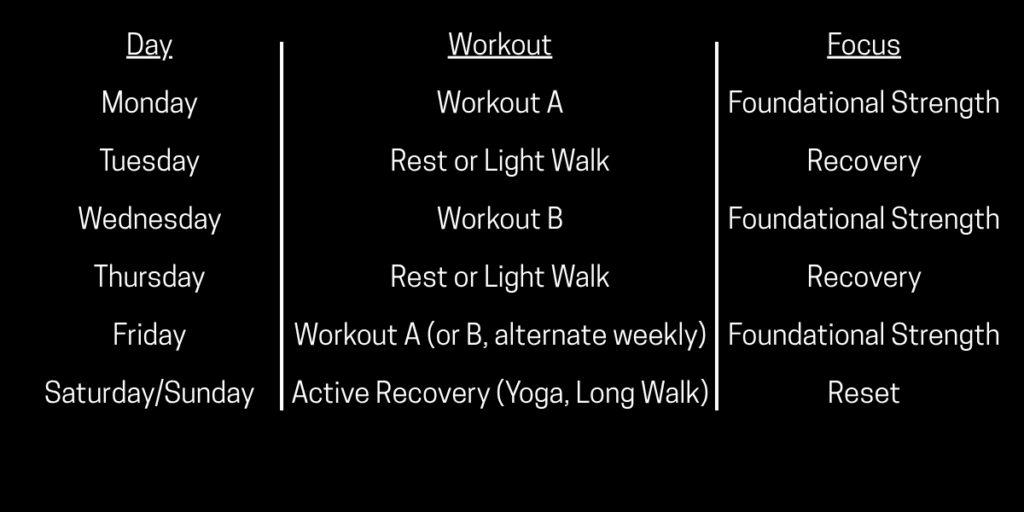
This 4-week home workout plan uses an A/B split: two different full-body routines that you will alternate throughout the week. Perform each workout 2-3 times per week, with a rest day in between (e.g., Mon/Wed/Fri).
Weekly Schedule:
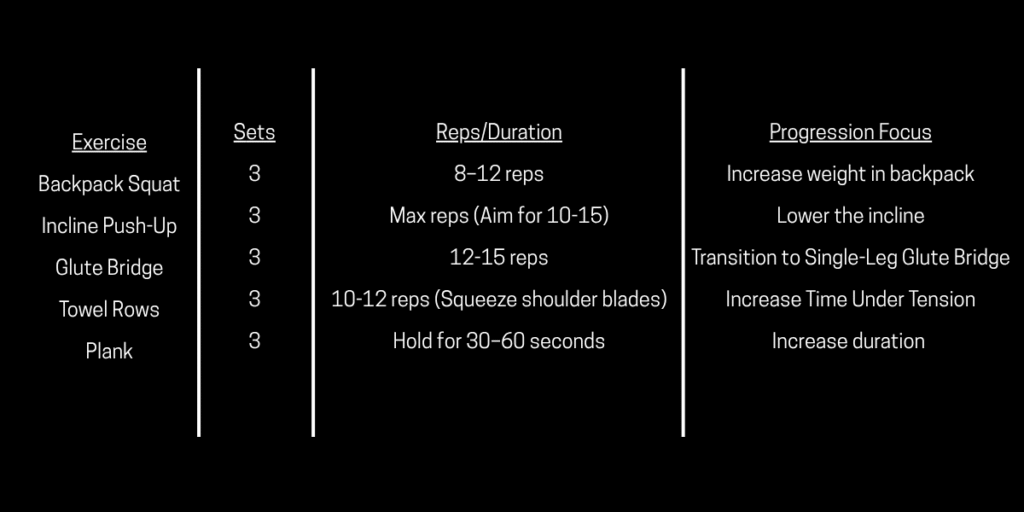
Workout A: Push & Hinge Dominant for Full-Body Fitness
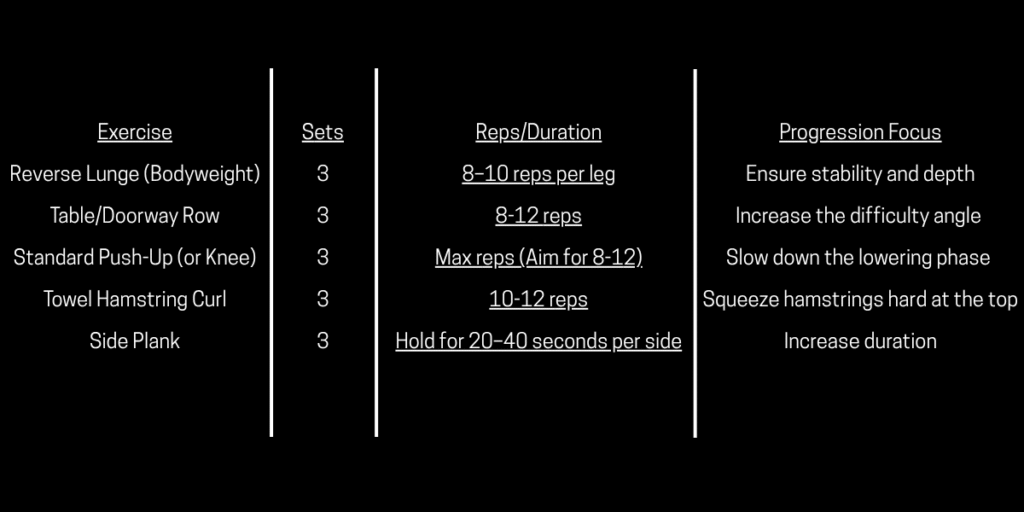
Workout B: Pull & Single-Leg Dominant for Balanced Fitness
Part 4: The 4-Week Progression Roadmap
The real difference-maker in your beginner strength training journey is how you apply progressive overload over time. Follow this roadmap to ensure you keep building strength every week.
Week 1: Focus on Form (Foundation)
Goal: Learn the movement patterns. Stop 2-3 reps short of failure on every set.
Key Focus: Watch videos of the movements and record yourself. If you’re doing the backpack squat, start with just an empty backpack to master the form. For the Glute Bridge, really focus on the glutes, not the lower back. This week is all about building a solid foundation for your strength training at home routine.
Week 2: Increase Volume (Repetitions)
Goal: Increase the number of repetitions for all exercises (Progression Method #1). If you did 8 reps of squats in Week 1, aim for 10 reps this week.
Key Focus: Maintain the perfect form you established in Week 1. Push yourself closer to failure, but don’t sacrifice technique. For your push-up, if you’re comfortable, try dropping the incline surface a little lower.
Week 3: Time Under Tension (Difficulty)
Goal: Introduce slow, controlled movements (Progression Method #2).
Key Focus: For all Squats, Lunges, and Push-Ups, take 3 seconds to lower your body, then explode up. This dramatically increases the muscle work without adding extra weight. For the Row, take 3 seconds to pull and 3 seconds to lower. This is a powerful technique for strength training at home.
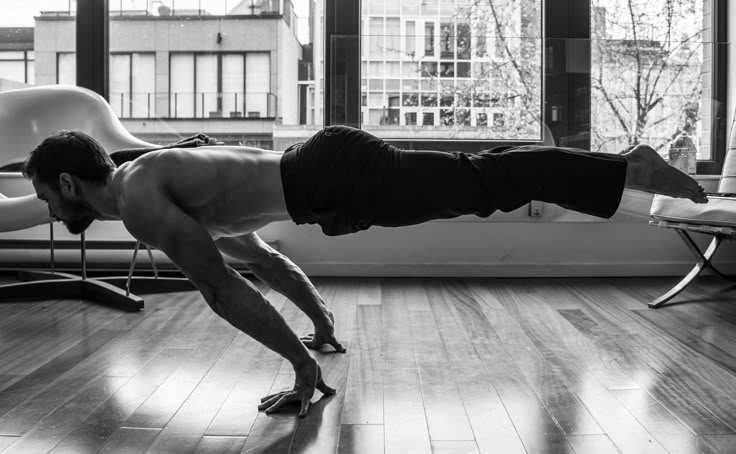
Week 4: Introduce New Resistance/Difficulty for Maximum Home Fitness
- Goal: Apply the hardest form of progressive overload (Progression Method #3).
Key Focus:
Squats: Add more weight to your backpack.
Glute Bridge: Move to Single-Leg Glute Bridges.
Push-Ups: Move your hands to the floor (even if you need to use your knees).
Plank: Increase your hold time by 10-15 seconds.
Part 5: Fueling Your Home Strength Training Results
You cannot out-train a poor diet. Nutrition and recovery are two non-negotiable components of any successful strength training at home journey.
Protein: The Building Block
Protein is the most crucial nutrient for muscle repair and growth. Your body needs it to adapt to the challenge of your home workout plan.
Actionable Tip: Aim for 20-40 grams of protein within an hour or two after your workout. Good sources include Greek yogurt, eggs, chicken, fish, or a simple protein shake. This ensures your muscles have the fuel to repair and grow stronger.
Sleep: The True Recovery Phase
Muscle is built when you are resting, not when you are lifting. Sleep is when your body releases the majority of its growth and recovery hormones.
Actionable Tip: Aim for 7-9 hours of quality sleep per night. Think of it as part of your beginner strength training—you schedule your workouts, now schedule your recovery. Quality sleep directly impacts your energy levels for your next strength training at home session.